Hidden Champions
← The Index

Bell Equipment

Articulated dump trucks for mining and construction
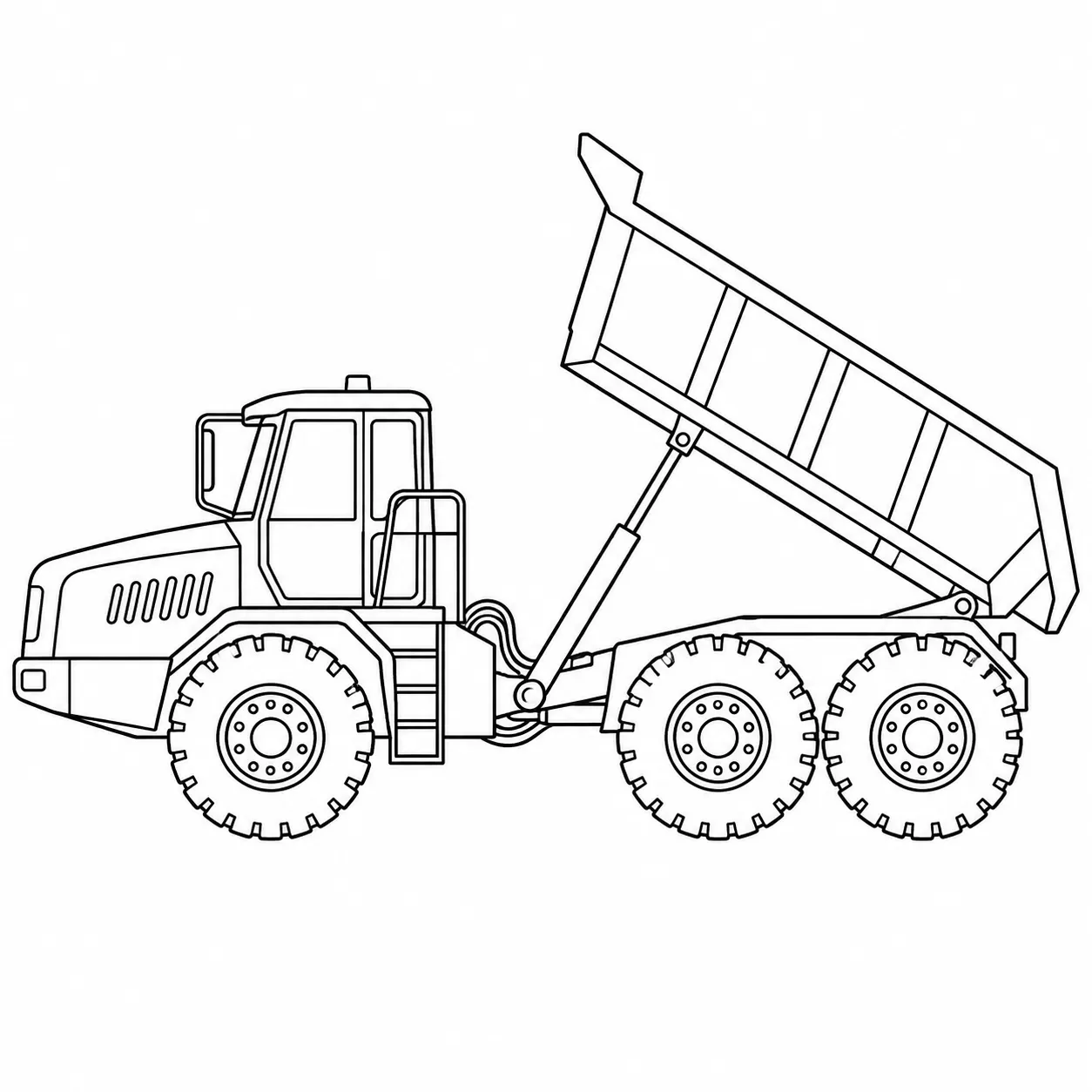
Line drawing of an articulated dump truck with a raised tipping bed
Industry
Heavy machinery
Country
South Africa
Founded
1954
Revenue
R11.15B / ~US$620M (FY2025)

The last specialist in one of earthmoving's smallest niches. From Richards Bay, South Africa, family-controlled Bell Equipment builds articulated dump trucks (the bend-in-the-middle haulers that keep moving where roads end), and it is the only company in the world for which that machine is the whole business.

In 1954, on a sugar estate near Empangeni in Zululand, a fitter and turner opened a repair workshop for farm machinery [1]. Irvine Bell had learned his trade at a northern Natal colliery, spent five years of the war as a military engineer, and come home to drill boreholes for farmers with a rig he had built himself around a Jeep engine [1]. The workshop was the obvious next step: the sugar farms were full of machines and short of people who could fix them.

Sixteen kilometres away, in the same year, surveyors were laying out a new town on the shore of a lagoon. They called it Richards Bay [2]. The company and the town grew up together (the deep-water harbour opened in 1976, Bell’s custom-built factory followed in 1984 [2][3]), and today the machines built there work in more than a hundred countries [4].

Which would be a conventional export success story, except for what the machine is. Bell makes articulated dump trucks, and the world market for articulated dump trucks is about 9,000 vehicles a year [5][6]. It is one of the smallest niches in heavy equipment, and one of the strangest, because the companies Bell shares it with are Caterpillar, Volvo, Komatsu and John Deere, and the niche has been quietly beating them.

The thesis

Every maker of articulated dump trucks except one is a diversified giant that could drop the product tomorrow and barely feel it. Some have: JCB built them and walked away [7]. Volvo, which invented the machine in 1966 and leads the market, bought a second ADT brand in 2014 and announced in March 2026 that it is shutting it down, citing costs and tariffs that made “continued operation unsustainable” [8]. John Deere solved the problem differently: for thirteen years it did not design an articulated truck at all, but sold Bell’s, painted green [9].

Bell is the exception: the only manufacturer on earth for which this machine is the whole company [7]. That focus is the story. So is the price of it: 2026 has brought a 25% American tariff on a product whose biggest market is America [4], a profit warning [10], a third-generation family CEO stepping down [11], and a controlling family that has twice tried and twice failed to take the company private [12]. A hidden champion under maximum stress is the best place to see what the moat is actually made of.

The Niche

An articulated dump truck (ADT, or simply “artic”) is a hauler in two halves. The front half carries the cab and engine; the back half carries a bin holding twenty to sixty tonnes of rock, ore or mud; and between them sits an oscillating hinge that does two jobs at once: it steers the truck by folding it, and it lets the two halves roll independently, so that all six driven wheels stay pressed to the ground however broken the surface is [13].

That joint is the entire point. A conventional rigid dump truck is faster and cheaper per tonne on a well-built haul road. But mines and construction sites spend much of their lives without well-built roads (in mud, on soft fill, on steep unprepared grades), and there a rigid truck bogs down or tips while an articulated one keeps crawling [13]. The ADT is the machine you buy for the state of your roads, which is to say: for the worst weeks of your year.

It is a serious product at a serious price, sold in tiny numbers. A lightly used Bell B50E resells for around $435,000–450,000, and a rival Komatsu with 25 hours on the clock fetched $580,000 at auction in 2025 [14]. Roughly 9,000 units a year worldwide, half of them in the United States [5]. For comparison, Caterpillar builds its entire global ADT line in a single factory in the north of England, inherited from a Durham engineer named David J.B. Brown; it took that plant more than fifty years to build its 70,000th truck [6]. One mid-sized plant, running half a century, covers the world’s largest producer.

That is why the niche stays a niche. Nine thousand units a year is a rounding error in a giant’s product plan, but the machine itself is unforgiving: a platform generation takes years and the customers judge it in mud, where a bad truck strands a mine in the wet season. Small stakes, high difficulty, slow reputations: precisely the combination that makes conglomerates leave, and specialists stay.

The Origin

Bell got to the truck sideways, through sugar. Irvine Bell’s workshop repaired farm machinery; by 1958 he had built a bigger one on his own smallholding, where his brother Rob and brother-in-law Malcolm Campbell joined him, his wife Eunice kept the books, and the firm took the name it still trades under as a holding company: I.A. Bell and Company [1].

The first product of consequence was a machine for the hardest job in the cane fields: loading cut sugar cane by hand. Bell’s answer, developed in the early 1960s and patented in 1964, was the Tri-Wheeler, a three-wheeled hydraulic loader with independently controlled drive wheels, nimble enough to work between cane rows [1]. Short of capacity, the family first licensed it to a Johannesburg locomotive builder. When the licence expired in 1975, Irvine’s son Peter, the engineer of the second generation, redesigned it around modern hydraulics and the family took manufacturing in-house for good [1]. The company that made that decision had eight employees [15]. Sixty years on, a descendant of the Tri-Wheeler is still in the Bell catalogue.

Irvine Bell died in 2011, at 91, at home in Empangeni, having been awarded a presidential order for his contribution to South African industry [16]. For a man who founded a global equipment manufacturer, he left an oddly quiet record: in two languages, I could not find a single directly quoted sentence from him. His son Gary described him as “humble, quiet and unassuming, with an enquiring mind” [16], and the record supports the adjectives: the voice is missing; the machines are everywhere.

The Climb

1984: the factory and the successor. Bell commissioned a purpose-built plant at Richards Bay, and Gary Bell, who had joined as an apprentice in 1970, became chief executive [3][15]. He would hold the job for 34 years [15].

1985: the bet. A year later, the company launched its first articulated dump truck, a 25-tonner [3]. Company anniversary material dates the first truck to 1984 [17]; either way, the timing was audacious: South Africa in 1985 was sliding into debt crisis and sanctions, and a farm-machinery firm in Zululand chose that moment to enter a market defined by Volvo and Caterpillar. The 40-tonner that followed in 1989 made the company’s name in the class [1], and by 1995 Bell was listed on the Johannesburg exchange with revenue around R500 million [3].

1999: the deal with the giant. In November 1999 John Deere began selling Bell-designed ADTs through its North American dealer network, badged as John Deere; from mid-2005 the trucks were even built in Deere’s own Davenport, Iowa plant [9]. Deere took an equity stake that grew to 31.4% of Bell [18]. For Bell it was distribution it could never have built alone. For Deere it was an admission, renewed annually for thirteen years, that designing its own truck was not worth it.

2003: the German hedge. On a former military training ground outside Eisenach, in Thuringia, Gary Bell and the state’s minister-president laid the foundation stone of Bell’s first factory outside Africa, a €4.5 million assembly plant planned for 60 employees [19]. It grew into the group’s northern-hemisphere anchor: around 270 employees and roughly 500 trucks a year by its twentieth anniversary [20].

2009: the near-death. The financial crisis cut Bell’s revenue by 50.6% in a single year. Machine sales fell 58%; production ran at times at 20% of the previous year’s volume; the group lost R272 million; and headcount fell from 3,224 to 2,076. A third of the payroll, gone in twelve months. “2009 has been the toughest and most challenging year in the Bell group’s history,” wrote the chairman, in an annual report that reads like a field hospital log [21]. The company survived it without losing either the family’s control or the product line.

2012: the giant becomes a competitor. In August 2012 Deere launched its own E-Series ADTs (“a 95 percent clean-sheet redesign,” its product manager said), and the North American arrangement ended [9]. Overnight, Bell lost its largest sales channel and gained a sixth competitor, one that kept the dealer network, the customer base and the Davenport factory that Bell’s trucks had warmed up. Bell re-entered America under its own name in 2013, through a newly formed Houston master distributor, Bell Trucks America [22].

2013–2016: the counterpunch. Rather than defend, Bell went upmarket: a 60-ton truck, the B60, unveiled at bauma Africa in 2013 [23] and productionised as the B60E in 2016 after eighteen months of testing at African mines [24]. It is a hybrid (the two-axle layout of a rigid truck with an articulation joint) designed for a specifically African frustration, as Bell’s marketing chief explained: mining customers ran 60-ton rigid trucks “but find there are always some months in the year in which they can’t be used, thanks to weather conditions making roads impassable” [23]. Volvo unveiled a 60-tonner the same season [24]; the arms race at the top of the class now runs between the inventor and the specialist.

2020: the divorce completed. In September 2020, Deere sold its 31.4% stake back to the family holding company, and Bell’s southern African distribution of Deere equipment wound down [18]. After 21 years, the entanglement with the giant was over, and the family owned 70% of the company.

The Market & the Model

Bell’s 2025 numbers describe a mid-sized, profitable, badly rattled manufacturer: revenue of R11.15 billion (about US$620 million), down 5% on the year; operating profit down 23%; net asset value per share up 4% to R61.74 [25]. The geography behind those numbers has quietly inverted twice.

The first inversion is where the money comes from. Europe was long Bell’s biggest external market; in 2025 the operating segments covering the rest of Africa and Zambia together booked R5.7 billion, more than Europe (R3.2 billion) and South Africa (R2.3 billion) combined, as African mining became the group’s biggest leg [26]. Meanwhile a single customer, its American master distributor, accounted for R1.7 billion, roughly 15% of group revenue [26].

The second inversion is where the trucks are made. Around three-quarters of world ADT demand sits in the northern hemisphere [20], and in 2022 Bell announced that primary ADT production would shift to the German plant, with Richards Bay pivoting to graders, components and contract fabrication [27]. The company Gary Bell once described as sending “nearly 65% of all the trucks we sell worldwide” out of Germany [28] is completing the logic of that sentence: build where you sell. Richards Bay (45,000 m² under roof, the bulk of Bell’s 3,605 employees [4]) keeps the group’s engineering heart, and loses the volume.

The sales machine on top is old-fashioned and vast for the company’s size: 114 independent dealers across some 450 locations, plus Bell’s own dealer operations in South Africa, the UK and Zambia [4]. In a market this small, with machines this critical, the dealer network (parts within hours, a mechanic who knows the mine) is as much the product as the truck is.

And Bell does not say how many trucks it builds. Unit volumes appear nowhere in its results or annual reports: the world’s only ADT pure-play does not publish the one number that would size it. The best independent yardstick is American financing data: in the year to September 2025, Bell held 8.5% of new US ADT sales, fifth behind Caterpillar (30.3%), Volvo (28.2%), Komatsu (12.9%) and Deere (12.4%) [14]. Note the fourth name: in the country where Deere sells the descendants of Bell’s own designs through its own dealers, the pupil outsells the master half again over.

The Moat

Run Bell against Hermann Simon’s hidden-champion traits and the striking thing is how pure a case it is, with one deviation that now defines its future.

Focus, taken to the limit. One machine category since 1985; articulated trucks are still around 80% of the manufacturing business [29]. Bell’s range (from 18 to 60 tonnes, in 6x6, 4x4 and low-profile underground variants) is the broadest line-up in the 2026 US buyer’s guide field, and the company calls it the largest in the world [7][4]. Everyone else treats the ADT as a catalogue entry. Bell treats it as the catalogue.

Integration, not integration theatre. Bell builds no engines and no transmissions. It buys Mercedes-Benz power, Allison gearboxes and Kessler axles, and concentrates its own engineering on the frame, the bin, the hinge and the software [28]. Gary Bell made the logic explicit: “We’re not locked into having to use one company’s axles, gearboxes and engines” [28]. For a company with 120-odd R&D engineers [15] competing against Caterpillar, spending none of them on diesel combustion is not a weakness; it is the strategy.

Africa as a proving ground. The B60E spent a year and a half on African mines before launch [24]; the hardest haul roads on earth are a ten-minute drive from the factory. Machines proven there sell everywhere: up to 70% of Bell’s ADTs ship to Europe and North America [1].

Appetite for the fight. The company’s competitive posture is best captured by its long-time CEO, relishing head-to-head demonstrations: “We love a shootout! That’s when we can show that our products are a little different, where we can deliver on better efficiency” [28].

And the structural gift: a market too small to lose. This is the part no rival can copy, because it is not a Bell property at all, but a property of the niche. To attack Bell’s position, a giant must fund a full product line, a dealer network and a decade of credibility for a share of 9,000 annual units. Volvo’s own second attempt shows how that maths ends: it bought Scotland’s Terex Trucks in 2014, rebranded it Rokbak in 2021, sold 40 trucks in America in 2025, and closed the business in March 2026 [8]. When the inventor of the category cannot sustain a second brand in it, the specialist’s seat is safe.

Simon’s model, though, has two more traits (independence and continuity of leadership), and there the story darkens.

The Cracks

The tariff vice. In October 2025 the United States imposed a 25% tariff on imported medium- and heavy-duty vehicles, articulated trucks included, “irrespective of origin” [4]. Every ADT maker imports into America (Cat from England, Volvo from Sweden, Bell from Germany and South Africa), but for Bell the blow is proportionally hardest: the US is half the world market, one American distributor is 15% of its revenue, and Bell admits it is absorbing part of the tariff out of its own prices [4][26]. The North American ADT market contracted about 20% in 2025 [4]; the German plant went onto a four-day week [4]; and in June 2026 Bell warned that first-half earnings would fall by at least half [10]. The tariffs helped kill Rokbak [8]. Bell is built of sterner stuff, but the same weather is hitting it.

The family discount. Since buying out Deere’s stake in 2021, the Bell family’s holding company has controlled 70.1% [26], and its conduct toward the other 30% has become the company’s most public wound. In 2021 it offered minorities R10 a share, below the market price and roughly a quarter of the company’s net asset value. The offer was so thin that the independent expert declined to call it fair and Bell’s own independent board rejected it as “not fair and not reasonable” [30][31]. In 2024 it returned with R53 (a 71% premium this time), and minorities still voted it down, 53% for against a 75% threshold [12]. Then, days after letting the offer lapse, family members sold shares below their own failed bid price, a sequence one analyst simply called “bizarre” [12]. One fund manager put what the ADT business would fetch from a strategic buyer at “R90 to R120 a share” against a 2024 offer of R53 [12], which explains the stalemate: the family will not pay what minorities think it is worth, and will not sell what strategics might pay for. The shares trade at a deep discount to book value; the champion’s own register prices seventy years of focus at a fraction of its stated worth.

Succession, unsettled. For its first 64 years, Bell had two chief executives: Irvine, then Gary for 34 years [15]. It has since had three in eight. The first non-family CEO left at the end of 2023; Irvine’s grandson Ashley Bell took over in January 2024, framed explicitly as management “returning to the family” [32], and in June 2026 announced he would step down at the end of August, after two and a half years, with the buyouts failed and earnings halving [11]. A company veteran, Izak van Niekerk, takes over; Gary Bell, in his seventies, remains chairman [11]. Leadership continuity (the Simon trait Bell exemplified for six decades) is now its most visible question mark.

And the home-base question. Bell’s own annual report names the rising cost of manufacturing in South Africa as a material risk and states, quietly, that the group is “evaluating offshore manufacturing options” [4]. The company that stayed in Zululand through sanctions, the 2009 collapse and two decades of infrastructure decay is, for the first time, saying out loud that it might not build everything there forever.

Takeaways

Pick a market the giants cannot justify. Bell’s protection is not a patent; it is that 9,000 units a year cannot fund a conglomerate’s ambitions but can richly fund a specialist’s. The moat is the niche’s smallness, and it is maintained free of charge by the rivals’ own accountants, as Volvo’s Rokbak closure just demonstrated.

Renting a giant’s distribution is growth with a repossession clause. The Deere years built Bell’s volumes, then handed Deere a warm market: today Deere outsells Bell in America with trucks descended from Bell’s designs. What you gain through someone else’s dealers, you eventually forfeit to them.

Buy the commodity, own the difference. Mercedes engines, Allison boxes, Kessler axles. And every scarce engineering hour spent on the hinge, the bin and the software that no supplier sells. For a small OEM facing giants, in-house everything is vanity; in-house the differentiator is survival.

Family control compounds in both directions. Seventy percent family ownership carried Bell through 2009 without panic and funds decade-long product bets. The same control has burned minority shareholders twice, priced the company at a fraction of book value, and made succession a family question instead of a market one. The trait that built the champion is the trait that now discounts it.


One for the replies: Bell’s moat is partly that its market is too small to attack: the giants’ accountants defend it for free. What other product category is protected mainly by its own smallness? I can think of a few. Hit reply; the best ones go in the next issue.

The Newsletter

Learn how hidden champions win their niches

One world market leader per issue: how they got to the top of their market, researched and explained. Unsubscribe anytime.