Largan Precision
Smartphone camera lenses
- Industry
- Optics
- Country
- Taiwan
- Founded
- 1987
- Revenue
- NT$61.1B / ~€1.7B (2025)
The maker of the moulded plastic lens stacks inside flagship smartphone cameras — a company almost nobody outside Taiwan can name, whose single share was for years the most expensive ever traded on the Taiwan exchange. It has never lost its technical lead. It has been losing anyway.
There is a Taiwanese word for it: 股王, stock king — the single most expensive share trading on the exchange. On 25 August 2017 that title belonged to a company that makes something you have never knowingly bought, in a town most Taiwanese would struggle to place, and its shares touched NT$6,075 intraday. One board lot cost over NT$6 million. It was the highest price ever paid for a share in the history of the Taiwan exchange, and the record would stand for eight years.
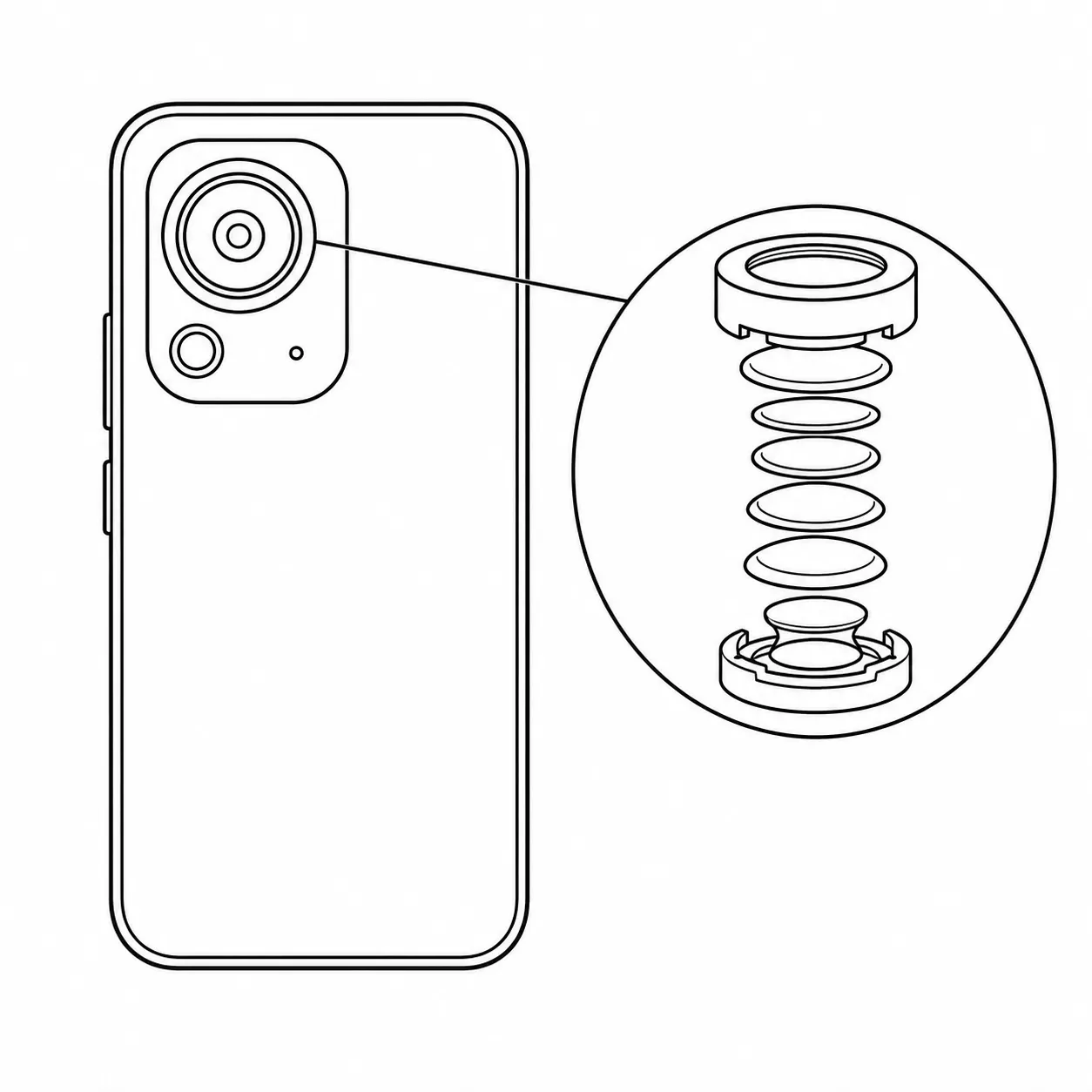
The company was Largan Precision, and what it sells is a stack of six to eight plastic lenses about four millimetres tall.
The Niche
Open a flagship phone and, in front of the camera sensor, sit six to eight individually moulded plastic elements — “6P,” “7P,” “8P,” the P for plastic — aligned inside a barrel. Largan’s own annual report reduces the process to four steps: injection moulding, trimming, coating, inspection. The difficulty is not in the steps. It is that every element is a free-form aspheric surface accurate to a fraction of a wavelength of light, produced by squirting molten plastic into a mould, at consumer-electronics volumes and yields, with the tolerance errors of eight stacked elements compounding against you.
The crown jewel is not the lens. It is the ultra-precision mould core the lens is born from — which is why 模具製造業, mould manufacturing, appears in Largan’s registered business scope as a line of business in its own right. Largan does not really sell lenses. It sells the ability to make the thing that makes them.
Why the money was so good
For most of the 2010s this company earned margins that belong in a software business. In FY2017 Largan’s gross margin reached 69.4% — a company record — on revenue of NT$53.1bn, for a net profit of NT$26.0bn and earnings of NT$193.66 a share. For scale: in the same year, TSMC — the most formidable manufacturer in Taiwan and arguably the world — was running a gross margin around 50%. A company moulding plastic was more profitable, per dollar of sales, than the company etching the world’s most advanced chips.
That gap has an origin, and the origin is a materials bet made in 1987.
The received wisdom in optics was that serious lenses are ground glass. Largan went the other way and committed to injection-moulded plastic, for three reasons that turned out to matter enormously once cameras moved into phones.
One: the asphere is nearly free in a mould, and brutally expensive in glass. Phone lenses need aspheric — and increasingly free-form — surfaces with steep gradients. In glass, that shape has to be ground and polished into every single element, one at a time. Canon, which built some of the first, needed curvature control to a ten-thousandth of a millimetre, purpose-built grinders and laser interferometers to make its early aspheres — and its output ran at more than a thousand pieces a month. Monthly. Injection moulding removes the problem entirely: the asphere is not carved into each lens, it is cut once into the mould core and reproduced. Zeiss engineers, writing on mobile phone optics, note that in professional glass lenses an asphere is “a significant cost driver” and gets used sparingly, while a phone camera module carries eight aspheric surfaces without blinking, precisely because these optics “are predominantly made of plastics manufactured by injection molding.” The hard part moves upstream into tooling — which is exactly where Largan had put its money.
Two: the cost advantage is cycle time, not cheap material. This is the part usually got wrong. Optical polymer is not meaningfully cheaper than optical glass by weight; the mechanism is speed. A 6 mm plastic lens moulds in under 30 seconds. The equivalent glass element takes up to 15 minutes. That is the entire economics of the smartphone camera in one ratio — a market that consumes aspheric elements in the billions per year is only reachable at a throughput glass cannot approach. Plastic optics also waste enormously more material in sprues and runners; the win is the clock, not thrift.
Three: the stack is roughly half the weight. Optical polymers run about 1.16 g/cm³ against 2.51 for common optical glass — at least a 2:1 advantage. That matters in a phone in a way it does not in a camera body, because autofocus works by physically shifting the whole lens module with a voice-coil motor; the moving assembly a phone VCM has to accelerate weighs on the order of 45 milligrams, thousands of times a day, off a battery. (Worth flagging honestly: no source I could find says Largan chose plastic in order to reduce actuator load. The physics is real and each link is documented, but treat it as a consequence of the material choice rather than a stated design rationale.)
None of this was a free win. There are only single digits of usable optical polymers against well over a hundred mouldable glasses, and they cluster in the wrong corner of the Abbe diagram — the high-index optical plastic OKP4 has an Abbe number of just 27, where ordinary crown glass is above 60. Correcting colour fringing needs large Abbe differences that plastics simply cannot supply, and the Zeiss paper states the consequence bluntly: colour correction in phone optics is “typically worse compared to all-glass lenses” at equivalent pixel pitch. Plastic also has a thermal index coefficient roughly twenty times glass’s, so focus drifts as the phone warms, and it is softer, more scratch-prone and more absorbent of moisture. Largan’s engineering identity for thirty years was beating those disadvantages with design and process, far past the point anyone thought plastic could go. Its answer to heat in 3D-sensing lenses, where the laser cooks the optics, was not to switch to glass but to add an element.
Hold on to the colour-correction problem. It comes back.
The eight years in the garage
The decision to bet on plastic was made by men with an unusual tolerance for grinding.
Lin Yao-ying, born 1933, was a civil servant. He moved into optics at 47 — an age at which most careers are closing, not opening. Before founding anything at all, he and a colleague fifteen years his junior, Chen Shih-ching, spent, by the family’s own account, eight years studying optics in the Lin family garage, on the conviction that Taiwan could build a world-class optical company the way Japan had. There was no company. There was no product. There was a garage and eight years.
They founded Dagen Precision Optical in 1980, opposite Tunghai University in Taichung, making glass lenses with two other founding families. The division of labour was fixed early and never really changed. Lin faced outward: driving off at 5 a.m. to visit camera factories across Taiwan, back at the plant in the evening, typing letters to foreign prospects himself. Chen faced inward: he ran the grinding shop, and when a new machine arrived he calibrated it personally — sleeping beside it in a sleeping bag, for a week or two at a stretch, until it behaved.
The founding insight arrived in 1987. Customers told Lin the coming wave of electronic cameras would favour plastic; and the Japanese makers held deep patent positions in glass aspherics, leaving little room to develop there anyway. So Lin set up Largan Precision as a separate, plastic-focused company, went around the patent thicket into a material nobody serious respected, and bought ultra-high-precision aspheric mould-core machining equipment at a time when almost nobody in Taiwan knew what to do with it. By 1991 Largan was the first company in Taiwan to mass-produce plastic lens elements. Domestic rivals followed only after 1995.
It entered through the bottom of the market — scanners and cheap digital cameras, where plastic’s optical inferiority did not matter — and then the market came up to meet it. Lin Yao-ying’s summary of himself, given to Business Today in 2013, explains the rest better than any strategy deck: 「我沒有任何興趣或嗜好,唯一的興趣就是工作!」 — “I have no interests or hobbies. My only interest is work.”
Still the leader. Still losing.
Here is the thing that makes Largan worth a newsletter rather than a case study: it never lost the technical lead. It is still, on the best available evidence, one to one-and-a-half generations ahead of anyone on earth at what it does. In FY2025 it earned a 50.4% gross margin on NT$61.1bn of revenue, while its Chinese rival Sunny Optical ran its handset business at 14.7% — half the revenue, nearly twice the gross profit. Largan’s group net profit exceeded that of a competitor with roughly three times its group revenue.
And it has been steadily displaced anyway.
Sunny Optical, founded 1984 in Yuyao, Zhejiang, made a decision in 2015 that Largan did not: it concluded customers wanted whole solutions rather than components, and rebuilt itself from an optical product manufacturer into an optical systems company. It put 200-plus engineers on module R&D, developed active alignment with third parties, and imported moulding techniques from semiconductor packaging. It went after the periscope assembly that folds a telephoto sideways into the phone’s body — the prisms, the motors, the alignment, the low-margin system knowledge Largan had deliberately declined to own.
In FY2025 Sunny’s hybrid glass-plastic lens revenue grew 95.8% and its periscope module revenue 55.9% — growth concentrated precisely in the architectures Largan had specified against. Ming-Chi Kuo’s supply-chain checks put Sunny’s share of Apple’s lens orders at around 5% in 2024, rising to 15–20% across 2025–26; for the variable-aperture lens going into the iPhone 18 Pro in the second half of 2026, Sunny is projected to take 40–50% of orders at an average selling price half again higher than today’s high-end 7P. Largan is still the first supplier of that part. It is no longer the only one.
Then the decisive blow, which came not from the rival but from the customer. Apple held its flagship cameras at seven-element lenses for three consecutive model generations while Largan had 8P shipping and 9P in development. Computational photography had quietly made a lower-specification lens good enough. Lin En-ping’s public response in 2021 was that Apple was deliberately cultivating a second supplier — reading an architectural shift as a procurement dispute.
That distinction is the whole story, and it has a name. In 1990 Rebecca Henderson and Kim Clark described architectural innovation: change not in a product’s components but in the way components are linked together. Their argument is that this specific kind of change is the one that kills competent incumbents, because deep component knowledge is exactly what conceals it. The firm keeps improving the part, correctly, by every metric it has ever used — while the value quietly migrates into the connections between parts.
Largan is the cleanest example of the phenomenon I have found. It won the component war so completely that it stopped being the war. Nobody built a better lens. They did not have to.
How Largan is answering
This is the part that has not been written up, because the answer is filed rather than announced.
The most rigorous published analysis of Largan’s decline — an essay by Shen Jung-chin and Chuang Hao-chun for Voicettank in March 2025, and still the best thing written about this company in any language — rests on the claim that Largan doctrinally refuses glass-plastic hybrid construction, and that this purism is why it could not answer Sunny.
Largan’s own FY2024 annual report, filed 21 April 2025, quietly disproves it. In the section listing technologies successfully developed, the company names the 1MG6P, 1MG7P and 1WLG7P — MG for moulded glass, WLG for wafer-level glass. A 1MG6P is one moulded-glass element plus six plastic: a glass-plastic hybrid, the exact architecture Largan is described as rejecting. The same report lists multi-group and two-group periscope lenses — the split-group design it had publicly specified against — and names moulded glass lenses and split-group folded telephoto as target mainstream products. Its 2026 investor calls now flag hybrid lenses as the next key specification upgrade.
The purist recanted. It did so without a press release, without correcting the record, in Chinese, in a statutory filing, while the definitive account of its rigidity was still being written.
And here is the twist that makes the delay sting. Remember the colour-correction problem — the one thing plastic structurally cannot fix, because no polymer has a high enough Abbe number. The remedy was published in 2012, in that same Zeiss paper on mobile phone optics: add a single glass element, “preferably close to the stop position,” to bring high Abbe number and anomalous partial dispersion into an otherwise plastic stack. That is a description of a 1MG6P. The fix Largan shipped in 2024 was sitting in the open optics literature, correctly specified, twelve years earlier. This was never a problem nobody had solved. It was a problem the best plastic lens maker in the world had reasons not to want solved that way.
The rest of the answer is being paid for in cash and land. Between late June and late July 2026 Largan bought three separate parcels of industrial land and buildings around the Taichung Industrial Park — 5,773 ping, about NT$2.57bn — in under a month. The seller of the largest was a cold-storage company: a firm that has spent three decades perfecting a component measured in fractions of a wavelength is buying a refrigerated warehouse. Chairman Lin En-ping explained the new fourth plant in one strange sentence at the January 2026 investor call: it is weighted toward process rather than capacity, “because the process is more complex, it needs more space.” A lens company building a factory for a process rather than a volume.
What that process is for is increasingly not phones. Largan’s highest-priority new business is optical connectors for AI data centres, and it landed its first CPO order in 2026. It can afford the wait: it has never issued a single share to raise money in seventeen years as a listed company, carries almost no debt, and sits on cash equal to more than two years of revenue.
There is an irony in the timing that is almost too neat. The NT$6,075 record Largan set in 2017 finally fell on 13 November 2025 — to Aspeed Technology, a Taiwanese designer of server management chips, at NT$6,335. The crown passed from the company that made phone cameras better to a company that makes AI data centres work. Largan’s own escape route is pointed at exactly the same place.
The Cracks
The risks are mostly in Largan’s own filings. Customer concentration is the acute one: its largest customer, unnamed even in a statutory document, went from 26% of sales in FY2023 to 36% in Q1 2025, and the report concedes that sales are “significantly concentrated in a small number of customers.” The company’s own “unfavourable factors” table admits that peers’ low-end products “are now close to our quality” — technical parity from below, conceded in a filing. Management warns that surging memory prices are squeezing the camera’s share of the phone’s bill of materials, and high-end lenses have been stuck around a fifth of the product mix since 2022 against forecasts of twice that. The diversification bets are real but early. And the governance is family-firm vintage: all three “independent” directors are former Largan or Ability Opto employees, and a company whose stated moat is master-to-apprentice craft transmission recorded 5.47 average training hours per employee in 2024 — a number someone should raise at an investor call.
Takeaways
If your moat is being better at one component, your specific vulnerability is a change in what that component attaches to. Largan never lost the lead. It lost the premise that the lead was scarce.
Depth actively conceals architectural change. The better you are at the part, the longer it takes to notice that the connections between parts have become the product. Every metric Largan trusted kept saying it was winning, and every one of them was measuring the wrong thing.
Choosing not to own the low-margin adjacent piece is a real strategy with a real bill. Largan judged what to make in-house by gross margin, and voice-coil motors diluted it. Protecting the blended margin protected the share price and surrendered the architecture.
When a company like this changes course, it will not tell you. It will file it — in the local language, years before it corrects the public record. Largan’s reinvention is underway now, and unresolved. Watch what they file, not what they say.