RATIONAL
Combi steamers for professional kitchens

- Industry
- Commercial kitchen equipment
- Country
- Germany
- Founded
- 1973
- Revenue
- €1.26B (2025)
You have almost certainly eaten a meal cooked in one of its machines, and almost certainly never heard of it. RATIONAL makes the steel box professional kitchens cook in, from a Bavarian town of 29,000, on one product category for fifty years. It did not invent that box. Three decisions, none of them the invention, are the whole lesson.
In February 2026 a combi steamer came off the line in Landsberg am Lech with a gold-plated control dial: the 1,500,000th the company had built, in the fiftieth year of the product [1]. It was not sold. It went to a children’s hospice in Bad Grönenbach [1][2].
You have almost certainly never heard of the company that made it. You have almost certainly eaten out of one this week. RATIONAL says around 180 million meals a day are prepared in its machines [2]: its own count, published without any working, and nobody is placed to contradict it.
What makes it plausible is the customer list. RATIONAL’s market is anyone cooking twenty hot meals or more per service, so hospitals, school and university canteens, company restaurants, prisons, service stations, supermarkets, bakeries [3]. The steel cabinet against the wall, humming, is more likely than not this one. And it is not the machine RATIONAL invented: the company that did is still selling against it, and has been losing for half a century.

Twenty-six years of one product. The only lasting dent came from kitchens closing, not from a competitor taking the business.
The market share is a company claim too, “around 50%” of the world market for multifunctional cooking systems [3], with nothing independent in public behind it, though Middleby’s 10-K names “Rational AG” among its major competitors [4] and Hermann Simon, who coined “hidden champion”, files it as world market leader without qualification [5]. All of it out of a Bavarian town of 29,000 people, on one product category, since 1973. In 2025 it turned €1.26bn of revenue into a 26.4% EBIT margin [6], against 9.8% for Electrolux Professional, a listed specialist in the same industry [7], and roughly 18% for Middleby, the American roll-up [8]. It builds steel boxes for restaurant kitchens and earns like a software company. Three decisions explain most of that, and inventing the thing is not one of them. The stress test arrives this year: American tariffs, on a company that until January built everything it sold on one continent.
The niche: one box instead of a kitchen
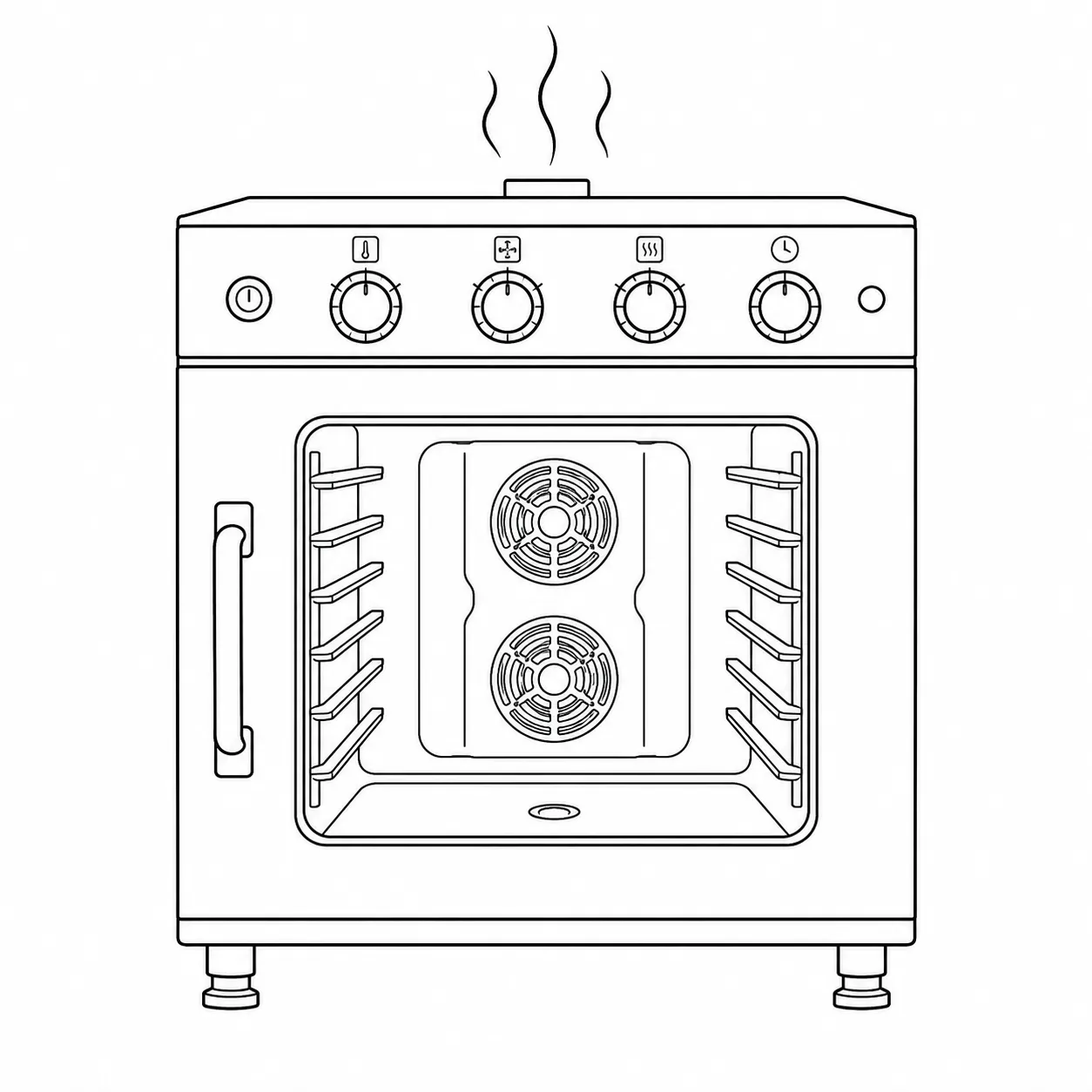
A combi steamer does three things in one cabinet: it steams, it bakes and roasts with circulated hot air, and it does both at once in any proportion, adjusting as it goes. It replaces a convection oven, a steamer, a tilting pan, much of the range, and the cook who stood over them. One box, twenty trays, chicken and vegetables and bread out of the same cavity, on a program, at 5:45 on a Tuesday when the sous-chef has called in sick. The hard part is not heat but climate: an exact temperature-and-humidity mix held while the doors open and twenty trays shed moisture at different rates.
What keeps the niche a niche is the money. The smallest six-tray machine lists near €12,800 [9], the twenty-tray cabinet that feeds a hospital €43,530 [10]. That is a capital decision, made once a decade, on the advice of a chef who has to believe it: no consumer volume, no impulse purchase, around 100 manufacturers chasing it [3]. Afterwards the machine is an annuity, 31% of revenue being parts, care products and service [3]. And with 4.8 million professional kitchens in the world [3][11], only about a quarter of them cook this way [3]. Fifty years in, most kitchens cook the old way.
The origin, and the inconvenient fact about 1976
Siegfried Meister ran kitchen technology for Wienerwald, a German roast-chicken chain, until 1973, and the complaint that reached him there was tough late-night poultry. His conclusion, quoted when he entered Handelsblatt’s family-business hall of fame, was characteristically literal: “Die Speisen sollten so schnell gar werden, dass sie gar nicht zäh werden können” (the food should cook so fast that it cannot get tough at all) [12]. He founded his own firm in Landsberg am Lech that year, at 35, with about twenty-five people, and in 1976 added steam to the hot air, delivering the first unit personally to Munich’s celebrity caterer Gerd Käfer [13].
He was not first. The combi steamer had been developed in the late 1960s by Burger Eisenwerke, an iron works in Herborn, Hesse [14][15]. In 1976, the year RATIONAL showed its first machine, Burger was sold to Juno, and Juno went into Electrolux in 1990, which sells that device’s descendants to this day [14][16].

The head start belonged to the company that treated this product as one line among many. The market went to the one that treated it as the only line.
The upper lane had the invention, the patents and a global distribution network. It is now one of the hundred-odd manufacturers competing with the latecomer [3]. What RATIONAL had was a decision: in 1978, two years after shipping its first combi steamer, Meister discontinued everything else the company made [13]. No fryers, no side business, no adjacent category. One problem, forever.
It has never pretended otherwise: the company page claims a market share, not an invention [17]. Which is the lesson, and it holds even for complicated things made of steel. You do not have to invent the product. You have to be the one company that treats it as the only product.
Why it wins: three decisions
RATIONAL prints its own answer: five “main pillars” of the success story, of which the first three, focus on commercial kitchens, specialisation in one kind of cooking and maximum customer benefit, have evidence underneath them [3]. What the list leaves out is where the company sold the result.
One product, and the things they will not build
Since 1978 the company has sold one category of machine and nothing else, which reads like a positioning statement until you follow it into the research budget. RATIONAL spent €75.8m on R&D in 2025, 6.0% of revenue [3]; in 2000 it was €7.0m and 4.6% of a much smaller one [18]. Spending is up almost eleven times, and the share, which sagged to a floor of 3.1% in 2012 [19], has climbed every year since.

The floor is 2012. Everything after it is a company putting a rising share of a rising revenue into the same single cavity.
The department is 310 people, described in the same phrase since 2002: physicists for basic research, chefs and nutritionists for applied research, engineers in various disciplines [3][20]. It has produced more than 600 patents, applications and registered designs, a number printed unchanged in nine consecutive annual reports [3][21], which is a tell of its own.
The refusals are the better evidence, because they cost something. Asked in 2023 whether a RATIONAL cooking robot was coming, chief executive Peter Stadelmann answered “Nein, das haben wir nicht vor” (no, that is not our plan), under a five-word headline: “Wir werden keine Roboter entwickeln,” we will not develop robots. What interests him is how the box should behave in a kitchen with nobody in it, and how it might complement the robots somebody else builds [22]. The most fashionable thing in professional kitchens is being invented one door down, and the market leader says publicly that it will not build it.
Six hundred chefs, and why they are on the payroll
In the late 1970s a heating element failed in a Bundeswehr test kitchen in Glückstadt, at the other end of the country. Meister flew up in his own light aircraft with a technician and a spare part, and had it running by eleven [23]. His axiom: a company earns its right to exist by producing benefit for the customer, and “out of the quality of that benefit comes success or failure” [24]. Fifty years on, that sentence has a headcount.
RATIONAL employs around 600 chefs [17][25]. Not consultants, not trade-fair demo staff: chefs, on the payroll, in a workforce of about 2,800 [3]. The series matters more than the number, because it turns a policy into a programme: over 200 in 2010 [26], 250 in 2012 [27], 300 in 2013 [19], around 400 in 2016 [28], around 600 now [25], with a trade-press count of over 500 in 2020 to check it against [29]. A rival copying the model this morning is copying fifteen years of hiring.
Two details sharpen it. The German report says not Köche but Küchenmeister, the examined master-chef qualification, which the English edition flattens to “chefs” [3][30]. And the company states plainly that “nearly all of its outside sales staff are chefs” [25]. This is not a specialist unit inside the sales force. It is the sales force.
They sit in four places. They cook: live cooking events since 1986 [28], hours long and free, still led by RATIONAL’s own chefs [31], at over 100,000 guests in 2016 [28] and 17,000 events plus more than 100 trade fairs in 2017 [21]. Until 2018 attendance was a formal non-financial performance indicator in the annual report, forecast and reported against like any other target [32]. Nobody guides shareholders on a marketing number. They answer the phone: the ChefLine, chef to chef, opened in October 2003 [33] and runs 365 days a year, free [34]. They teach: Academy RATIONAL since 2006 [24], on a ladder from free to paid, a free three-hour Basis Academy, €375 for the same in your own kitchen, €965 a day for process consulting [35]. And they develop, from inside R&D, as they have since 2002 [20].
Why go to the trouble? The answer, unchanged in fifteen years, is more specific than “customer focus”. RATIONAL’s chefs “see themselves, not as salesmen, but as partners and consultants. They speak the customers’ language and are familiar with their wishes and problems” [26]. Or: “who better to understand our customers than our chefs in the sales process?” [27]. The mechanism is a return path. Chefs in other people’s kitchens “transform practical bottlenecks into constructive questions” [28], and the questions travel back to the physicists: the sales force doubles as the research instrument.
Two honest qualifications. Chefs on staff are not unique: UNOX, the fastest-growing challenger, runs corporate chefs and will put one on your oven’s microphone [36]. The defensible claim is not exclusivity but scale and vintage, forty years of it at a headcount nobody else discloses. And the pool is draining: RATIONAL’s own outlook records chefs leaving the trade permanently, restaurants kept running by unskilled and semi-skilled staff [3]. That makes the machine more valuable and RATIONAL’s hiring harder, in one sentence.
Nine-tenths abroad, one subsidiary at a time
Ninety per cent of what Landsberg builds is sold outside Germany [3]. In the late 1990s it was 74% [37], so the climb is real, but the honest word for it is not early: the first foreign sales company came in 1991, in the UK, eighteen years after the company started [24]. The honest word is thorough.
The difference is the channel. RATIONAL sells into more than 120 countries through 32 subsidiaries, 22 of them sales companies [3][25], rather than handing a country to a distributor. The doctrine is written down: the 2000 annual report identified 22 “A-countries” holding 80% of the untapped global potential, and RATIONAL already had subsidiaries in eleven of them [37]. Twenty-five years on the same report says the network is extended “organically, step by step” [3], and it has been. In fifty years there has been one acquisition of consequence: FRIMA, the French distributor Meister found selling his ovens under its own name, a FRIMA sticker over the RATIONAL logo, bought outright in 1992 [38].

The selling is global. The company is not: half the revenue arrives from places with no factory in them.
Which is where the model shows its seam: 55% of the employees sit inside Germany, and until the Suzhou plant was finished this January every machine in the world was built in Europe [3][39]. That is an export footprint in the clothes of a global one, and the difference is about to be billed.
The cracks
One continent, and a tariff wall in the biggest growth market. The United States is about 20% of revenue and the market the chief executive calls the most important for the next ten years [40], and every machine sold there crossed an ocean first. Tariffs cost roughly €13m in 2025: “We were largely able to offset the additional tariff costs of around 13 million euros,” said finance chief Jörg Walter [6]. That worked once. A 4.9% US price increase went in this February [41], and the first quarter still came in at a 23.9% EBIT margin [42]. Then the refund claim lodged against the tariffs themselves [41] paid out around €14m in the second quarter, without which the company concedes cost of sales would have outgrown sales [43]. Guidance is 25–26% for the year, below 2025 [43]. No plan to build in America has been announced. The mitigation is cost control, which is a bet.
Asia is going the other way. It was the only region to shrink in 2025, down 11% [6], and China kept falling through the first half of 2026 [43]. The answer, a cheaper China-only machine out of Suzhou [39], is sensible and also an admission: a market where local competitors multiply and a premium import gets designed out is how equipment champions lose the future while still holding the present.
The register is concentrating while the board ages. This is a family-controlled hidden champion never run by the family: no Meister has sat on the management board, which makes “Man soll von Rational reden” (they should talk about Rational) [12] a governance structure, not a modest remark. Ownership is the part that moves. In May 2025 the founder’s widow gave her entire 16% block to her daughter Franziska Würbser for nothing [44], leaving Würbser near 31.5%, her sister at 15.9% and co-founder Walter Kurtz at 7.8% [45]. Kurtz, born in 1945, still chairs the supervisory board nine years after Meister’s death, with no announced successor [41]. Neither is a problem today. Both become one without warning.
Their own risk report names the real one. Not competition, not the cycle: suppliers. “The complete loss of a major supplier… could lead to interruptions in production” [3], a sentence the chip shortage already turned into airfreighted boards and half-built ovens in warehouses [46]. They name a second, that “new, larger competitors… could emerge as a result of mergers” [3]: Italy’s Ali Group took Welbilt private in 2022 at an enterprise value of $4.8bn [47]. Though the fastest-moving rival is no giant: UNOX, a family firm near Padua, booked €330m in 2024, up 14%, orders up 17% [48], selling on price and speed in the same kitchens.
Takeaways
You do not have to invent the product. You have to decide it is the only product. Burger Eisenwerke got there first and its lineage sits inside Electrolux today [16]. RATIONAL arrived late, dropped everything else in 1978 [13], and spent fifty years refusing the adjacent thing. Invention is an event. Focus compounds.
Hire your customer, then keep hiring for fifteen years. Six hundred chefs is not a marketing expense, it is the moat and the research instrument at once. Rivals employ chefs too, so the advantage is not the idea. It is that RATIONAL started in 1986 and never stopped, and a hiring programme is the one asset nobody buys in a quarter.
Selling everywhere is not the same as being everywhere. Nine-tenths of the revenue is foreign, 55% of the people German, every factory on one continent until this year [3]. Distribution globalises faster than production, and a tariff is the bill for the gap.
The Puzzler
RATIONAL’s market has been three-quarters empty for fifty years [3], and every one of those hold-outs has a chef who has seen the demo and said no.
So: what is the real reason a kitchen that could obviously benefit from one still doesn’t have one? Money, training, distrust of automation, or something a supplier cannot see from outside? If you have worked a line, hit reply. I read every one, and the best answers go in a future issue.